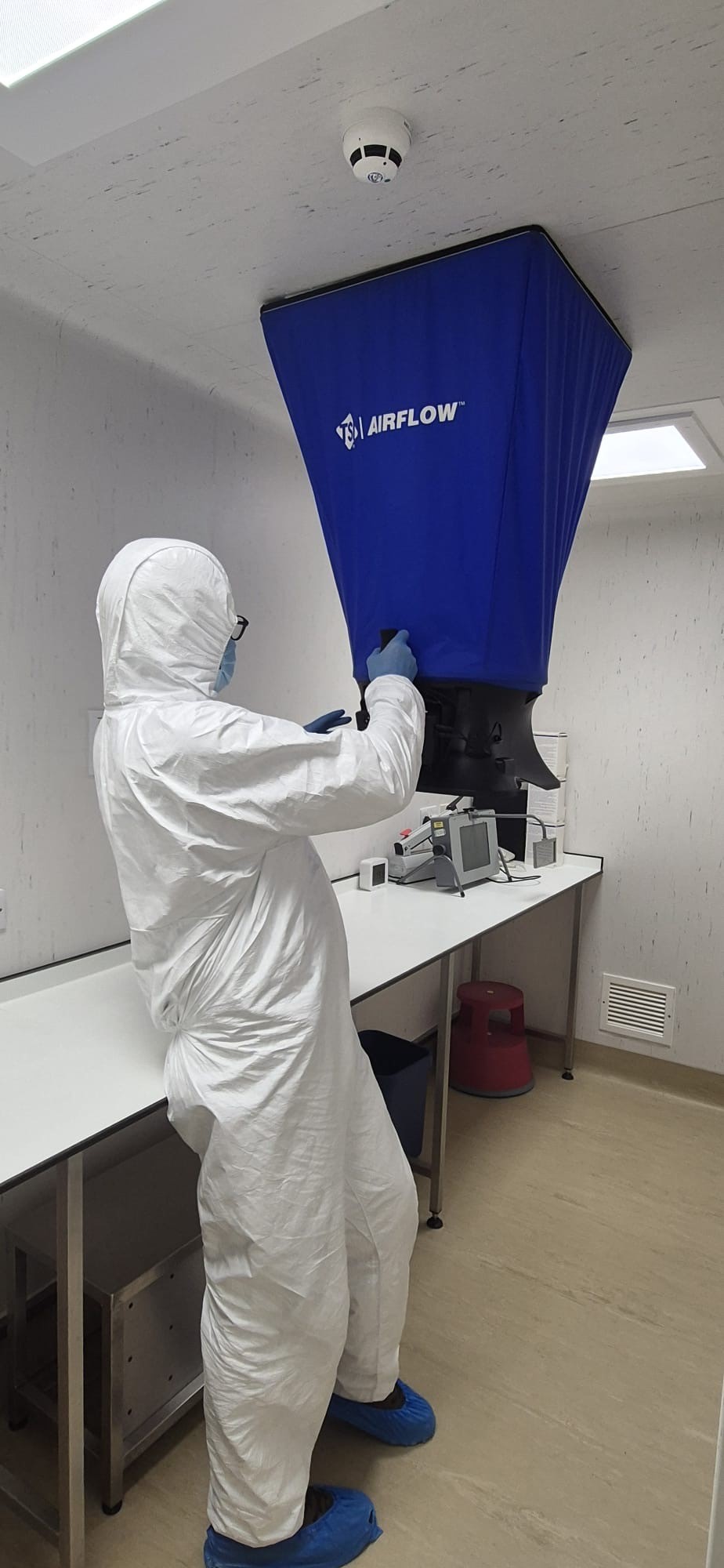
Validation is an important process for any cleanroom. It serves to ensure that the cleanroom is properly installed and designed for its intended ISO classification and that all of the components (facility, environment, equipment) meet regulatory requirements and other defined standards.
Our validation process entails a thorough inspection and several tests, whereafter the cleanroom is certified to a specific class indicating its level of control, usually to an ISO 14544-1 class.
Validation has several phases, beginning with design qualification, and ending in final certification. Some of the tests performed in these phases include airflow volume and velocity tests, HEPA/ULPA filter leak testing, air movement visualisation (smoke testing), room pressurisation, room recovery, airborne particle count tests, relative humidity, temperature, and other testing conditions.
We are specialists in the testing and reporting of cleanrooms to the ISO 14644 series of classification. The report you will receive following your test meets the requirements of ISO 14644 and if requested EU GMP ensuring client facilities are audit ready and compliant with the requirements of regulatory bodies.
As-built. An empty cleanroom not yet populated with any equipment and not in use.
At-rest. The cleanroom has been populated with any equipment required but is not in use, ie no moving parts and no personnel in the room during the test.
Operational. The cleanroom is fully operational and operating in accordance with the defined process.
Cleanroom Qualification is the overall process of assessing the level of compliance of a cleanroom or piece of clean air equipment with its intended use.
To meet the requirements for BS EN ISO 14644 Parts 1, 2, 3, 4 and 7a cleanroom must be tested for:
Airflow measurement – Volume and velocity
Airborne particle count
HEPA filter integrity test
In addition to the above ISO requirements, if your process requires EU GMP qualification, Annex 1 asks for additional tests for the qualification of cleanrooms and clean air equipment (where relevant to the design/operation of the installation):
- Installed filter leakage and integrity testing
- Air pressure difference measurement
- Airflow direction and visualisation
- Microbial airborne and surface contamination
- Temperature measurement
- Relative humidity measurement
- Recovery testing
- Containment leak testing